
Understanding the Value of Workplace Duress RTLS in Staff Protection
911Cellular
|
This National Safety Month, healthcare leaders are deeply focused on a unifying goal: protecting the caregivers who dedicate their lives to patient care. For leadership teams overseeing complex, integrated health networks, this means building a safety culture that spans multiple care structures, from high-traffic emergency departments to quiet outpatient clinics and decentralized home health environments.
But in a fast-paced medical ecosystem, security needs to be as dynamic as the clinical workflows it supports. Traditional, stationary alarms are no longer enough when staff are constantly on the move. To bridge this gap, many enterprise health systems are turning to Real-Time Location Systems (RTLS) to address the realities of workplace duress.
However, implementing an advanced security network requires a thoughtful approach– one that recognizes that the success of any safety tool relies entirely on staff adoption. If a platform doesn't explicitly prioritize personal privacy, clinical teams are understandably hesitant to embrace or utilize the system daily. For healthcare leaders, true operational efficiency is achieved only when safety infrastructure actively supports and respects the day-to-day realities of the caregivers who use it.
Aligning Safety with Workplace Culture
With such powerful technology, the deployment process requires careful, deliberate planning. When hospital executives evaluate location-aware platforms, the strategy must quickly move beyond the hardware's technical specifications to focus on a far more critical element: organizational trust. Progressive healthcare leaders know that the relationship between administration and frontline staff is built entirely on mutual respect.
This is where clear, transparent communication becomes essential. Applying continuous asset-tracking logic to human beings can quickly damage morale. No clinician wants to feel like their every step is being logged, mapped, or scrutinized during a well-deserved break, a shift transition, or a private moment in a staff restroom.
This isn't just a cultural concern; it is a measurable operational bottleneck. Implementation data from peer-reviewed studies show that a lack of trust in how tracking data will be used is directly correlated with a sharp drop in staff adoption. When healthcare facilities attempt to mandate continuous surveillance systems, research indicates that persistent privacy anxieties often impede effective implementation, sometimes leading staff to actively resist or distance themselves from the equipment.
The Evolution of Location Data: Accurate, Available, and Aligned
Healthcare has always relied on a highly mobile workforce. Nurses, physicians, and technicians naturally move across expansive floors, navigating corridors, specialized units, and waiting areas throughout a single shift. What has fundamentally changed, however, is not the mobility of the staff but the maturity of the technology built to protect them.
In the past, real-time location tracking was often considered an emerging, cost-prohibitive, or technically inconsistent tool. Today, precise location-based intelligence is widely available and highly reliable, and it can be thoughtfully incorporated into complex clinical environments without causing friction.
When an emergency escalates, legacy infrastructure– specifically antiquated, hardwired-only duress systems– presents significant operational challenges. Requiring a caregiver to physically travel to a fixed wall or desk location just to trigger an alert is incredibly cumbersome in a high-stress environment. Furthermore, a hardwired-only signal cannot adapt if the area of impact becomes a moving target, leaving responders without a clear picture of a dynamic situation.
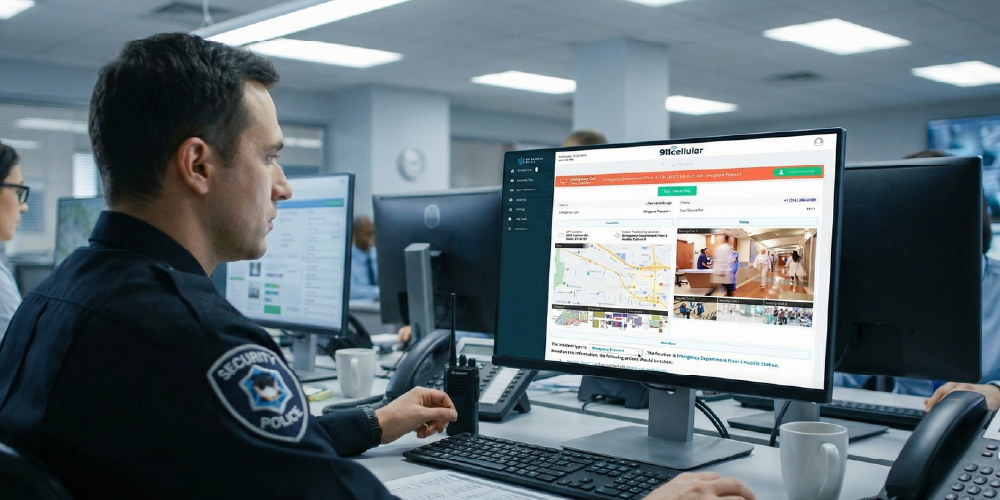
By contrast, incorporating modern, accurate location data does far more than just guide security to the individual in need. It gives the centralized command center immediate situational awareness, pinpointing exactly which security cameras to monitor or which access control points to adjust. This precision enables thoughtful integrations across the facility's entire security landscape, ensuring that separate networks communicate seamlessly when seconds count.
Inside the Workflow: How Event-Triggered, Time-Bound Tracking Works
To deliver ironclad protection without crossing ethical boundaries, industry best practices point toward maintaining a strict operational divide between tracking inventory and protecting personnel. While some safety networks on the market are designed to broadcast location data 24/7– which can certainly serve a valid purpose for asset management or patient wandering protocols– applying that same continuous surveillance model to clinical staff often introduces unnecessary friction.
- Phase 1: Zero-Data Standby Mode: Under normal operating conditions, the employee's location data is entirely non-existent to the network. The wearable duress device rests silently on a badge reel or lanyard, acting as an inactive shield. It does not log, track, or transmit any geographical coordinates during regular, peaceful shifts.
- Phase 2: Instant Incident Triggering: The moment a staff member activates the badge– whether via a discreet press to flag a low-tier verbal escalation or a high-severity emergency– the platform instantly wakes up. It broadcasts hyper-precise, room and floor-level coordinates straight to security dispatchers in real time.
- Phase 3: Automated Security Orchestration: Upon activation, the platform immediately leverages this precise location data to trigger integrated security tools across the facility. By instantly syncing with the nearest surveillance cameras, adjusting access-control barriers, or initiating localized alerts, the system dramatically improves visibility and situational awareness for responders, thereby significantly enhancing the speed and effectiveness of the intervention.
- Phase 4: Time-Bound Visibility for Responders: Once activated, the real-time location sharing remains live only for the duration of the incident. This ensures that if a clinician is forced to move or retreat during an active crisis, responders can continuously track their path and find them immediately, without extending administrative oversight a second past the event lifecycle.
Expanding Enterprise ROI Through Interoperability
Earning staff buy-in for a location-aware safety system becomes incredibly straightforward when leaders shift the conversation from how the technology tracks to what the technology triggers. When clinicians understand that their duress badge isn’t a passive monitor, but rather a tool that activates an entire network of protective infrastructure, true adoption happens naturally.
By demonstrating the immediate, interconnected response that occurs the moment an emergency is flagged, administrators can clearly show staff how system interoperability translates directly into their personal safety:
- Instant Visual Backup: Leaders can show staff that a button press doesn't just alert a distant dispatch office; it interfaces natively with local security cameras to instantly pull up live video feeds from the locations closest to their exact location. This gives response teams immediate eyes on the scene, ensuring security knows exactly what they are walking into and what level of de-escalation is required.
- Access Control Overrides: Care teams feel more secure knowing the platform can connect with electronic door hardware to automatically lock down specific wings or open secure pathways. This automatically limits a threat's mobility and creates a protective barrier for surrounding units without requiring frontline staff to manually manipulate locks during a crisis.
- Predictive Safety Analytics: Proactive leaders can explain to staff that anonymized, aggregated location data from past activations is used to create visual heat maps. This trend analysis doesn't track individual movements, but it does pinpoint weak spots in facilities. This empowers management to deploy additional security personnel or refine clinical workflows precisely where staff statistics show they are needed most.
- Objective Post-Incident Support: Staff deeply appreciate knowing that the platform logs incident data automatically, from the initial button press to final resolution support. This completely removes the burden of tedious post-crisis paperwork from busy clinical teams and provides clean, undisputed audit trails that support staff accounts and simplify compliance reporting.
Final Thoughts
Fulfilling an organization's duty of care is never as simple as choosing the most robust technology on the market; it is a nuanced balancing act that requires immense strategic thoughtfulness. Health systems could deploy the most expensive, highly integrated network available, offering continuous visibility into all assets and environments at all times– but if that framework introduces "Big Brother" vibes into the clinical space, the initiative will backfire. Frontline staff will understandably decline to adopt or wear the tools, leaving them unprotected and resulting in the same outcome as having no security infrastructure at all: low morale, a fractured workplace culture, and caregivers leaving the organization.
True enterprise safety cannot exist without employee trust. By actively choosing to move away from continuous tracking and instead deploying intelligent, event-triggered duress technology, healthcare leaders can successfully navigate this dilemma. The result is a powerful, integrated security infrastructure that hits the perfect balance: one that honors, respects, and protects the privacy of our healthcare heroes.
Related Articles
National Safety Month: Supporting Our Healthcare Heroes in the Fight Against Workplace Violence
June 1 marks the beginning of National Safety Month, a time to recognize the dedication of our...
Protecting Every Shift Without Breaking the Bank: The Scalability of Software-Based Duress Alarms
Healthcare systems are caught in a complex operational pincer movement. On one hand, the mandate to...
What the “Healthcare is Human” Rally on Capitol Hill Means for Frontline Safety
On May 21, 2026, Capitol Hill was filled with hundreds of frontline doctors, nurses, and medical...
Protecting Cleveland’s Caregivers: A Look at City Council’s Pending Healthcare Safety Legislation
Every day, healthcare workers and emergency responders step into high-stress environments to take...
What Healthcare Leaders Should Know About Illinois SB2713
The conversation around workplace safety in healthcare has taken center stage across the country,...